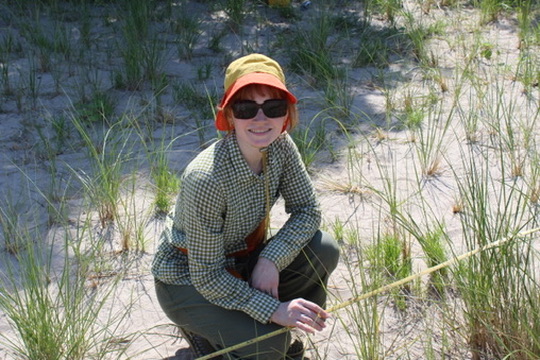
PhD Candidate and SRIJB Research Student Grace Damiano.
SRIJB Graduate Student Grace Damiano has been leading research to assess the effects of a dune planting project spearheaded by the National Wildlife Federation’s Resilient Schools and Communities program (RiSC). The project, supervised by Dr. Jennifer Cherrier, uses a dual-approach of high resolution and low-resolution monitoring to provide precise data on beach dynamics and an accessible long-term monitoring plan for citizen scientists. RiSC has been connecting communities across New York City to nature by bringing groups from schools and other organizations to plant native American beachgrass (Ammophila beviligulata) at Coney Island Creek Park. Coney Island Creek Park sits on the north-eastern stretch of the Coney Island peninsula and provides valuable habitat and recreational opportunities for communities in south Brooklyn. The area also experiences erosion of the dunes into their streets and homes, which RiSC’s project seeks to alleviate. Coney Island Creek Park has also been experiencing sand accretion for the last few decades, putting increasing pressure on the ecosystem and surrounding community as sand continues to pile up.
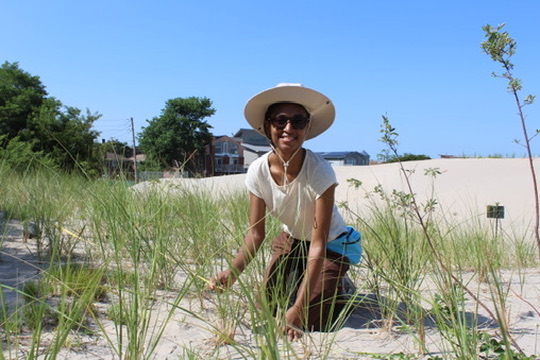
Brooklyn College undergraduate student Kayla Gillens collecting data on dune grass.
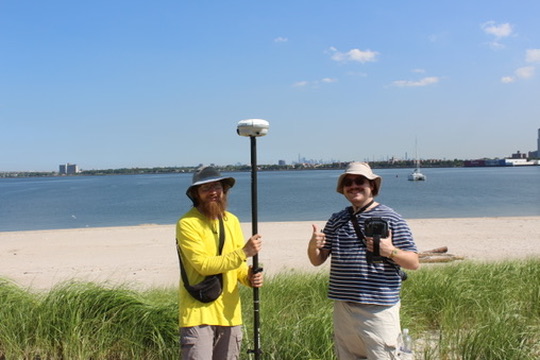
American beachgrass and other native species of grass can reduce erosion by forming an underground network of root systems that help hold sand in place. To assess how these grasses and other plants found on the beach are interacting with sand, I have established six transects across a 100-meter stretch along the beach. Along these transects, I am assessing the size and location of different species of plants, collecting sand grain samples, and collecting elevation data. Master’s student Matthew Wojick has been instrumental in collecting elevation data, and intern Kayla Gillens and undergraduate student Dovid Edekopf have provided outstanding support in data collection. These data will allow me to determine how the presence or absence of plants influences erosion, accretion, and sand movement across the beach, in addition to tracking the survival and growth of newly planted grasses by RiSC volunteers. This project will also develop a long-term monitoring program for RiSC that can be carried out by citizen scientists.
Brooklyn College Masters student Matthew Wojczik and undergraduate Dovid Edekopf taking elevation readings on the dunes at Coney Island Creek.
Data collection over the summer went well, and the team observed incredible natural habitat across the beach. On July 24th, they witnessed a tiger swallowtail (Papilio glaucus) laying eggs on a black cherry tree (Prunus serotina). People on the beach have expressed interest in the project and have told Grace and the team how important Coney Island Creek Park is to them. They love getting to spend time out there and look forward to sharing their results soon!